You are scrolling a marketplace feed when a listing stops you: a pallet stacked with boxed electronics, described as unclaimed Amazon returns, priced at a couple hundred dollars, with a note that it must be picked up today. The photo looks convincing. The price looks like a shortcut into reselling. In most cases, it is a script that gets reused across dozens of listings. Learning how to spot fake liquidation pallet ads comes down to recognizing a small set of repeatable patterns and knowing which questions a real seller can answer without hesitating.
Why the fake pallet pitch works so well
Legitimate liquidation is a business-to-business trade. Retailers, e-commerce companies, and third-party logistics warehouses sell returned and overstock merchandise in bulk, usually to buyers who hold a resale certificate and who buy repeatedly. Margins are thin, competition is real, and the people who do it well tend to buy from the same auction platforms and regional liquidators over and over.
Scammers borrow that vocabulary, manifested, unmanifested, overstock, mystery pallet, truckload, because it sounds like an industry. Then they attach three levers:
- A price that implies a windfall. If a listing claims new electronics and asks a fraction of what those items sell for, ask yourself why a business would not route that inventory through a channel that pays more.
- Urgency. Three left, truck leaves at 5, deposit today. Real sellers with real inventory do not need to rush a stranger.
- Distance and anonymity. The pallet is always at our warehouse with no address, or two states away, so you cannot look at it in person.
How to spot fake liquidation pallet ads: the red-flag checklist
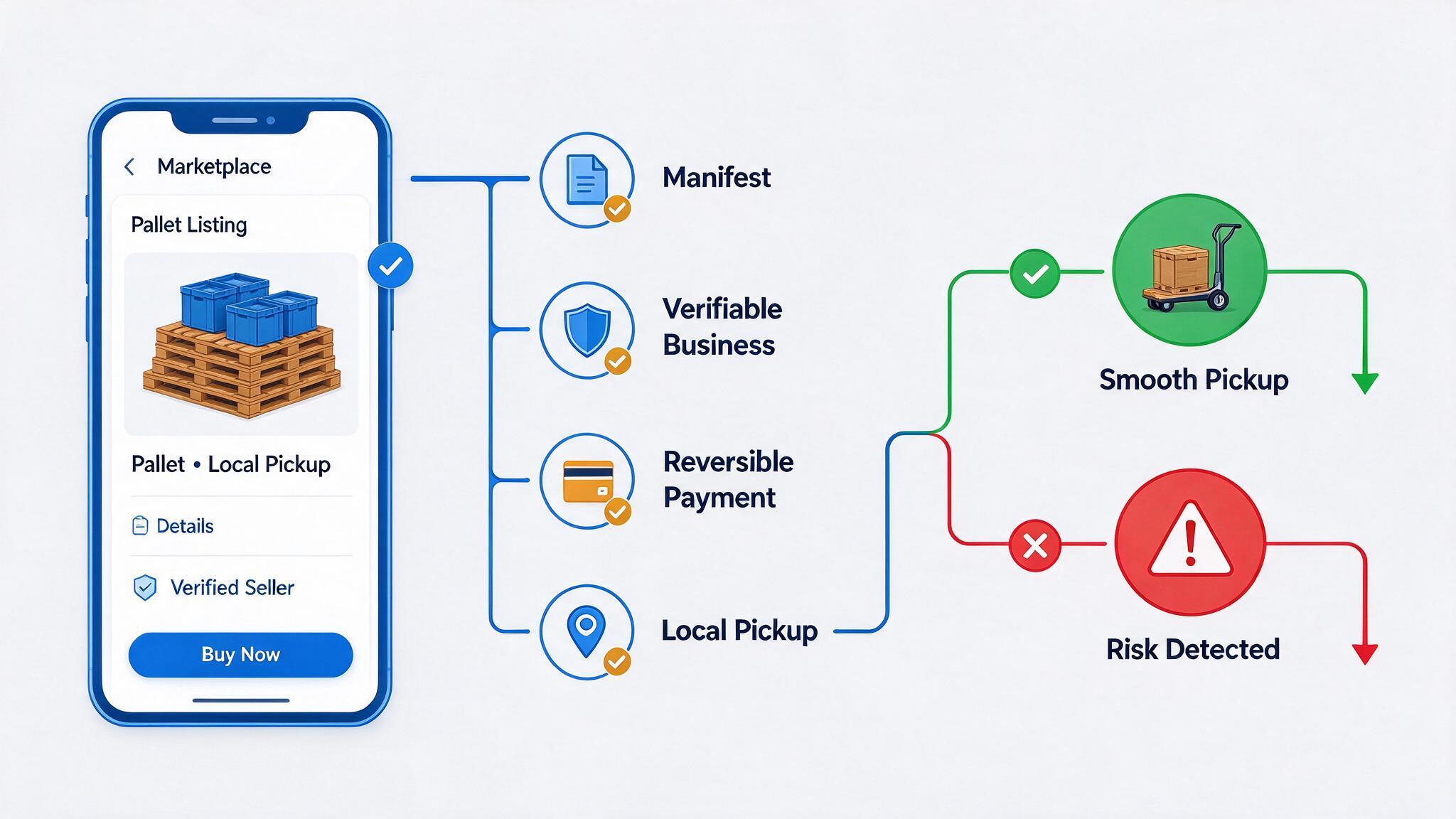
Run every listing through this table before you reply to the seller. One red flag is a question worth asking. Three is a walk-away.
| Red flag | What it looks like | Why it matters |
|---|---|---|
| No real manifest | Seller promises high-value items but sends only a screenshot, a generic PDF, or a sample manifest from a different pallet | A manifested load comes with an item-level list for that specific pallet. Without it, you are buying a sealed box |
| Irreversible payment only | Zelle, Cash App, Venmo friends-and-family, gift cards, wire transfer, or crypto | These leave you with almost no dispute path. Consumer agencies, including the FTC, repeatedly warn that scammers steer victims toward them |
| Recycled photos | Clean studio shots, watermarks from another company, or the same image used across several listings | Run a reverse image search. A real seller photographs their own freight |
| Pressure and deadlines | Countdowns, deposit to hold, I have five other buyers waiting | Manufactured scarcity is the oldest tool in the scam kit |
| Thin or clustered history | A profile created recently, or a burst of five-star reviews inside one week | Real resellers accumulate a long, uneven trail of transactions |
| No inspection, no pickup | Shipping only, prepaid only, warehouse is closed to visitors | Local pickup is normal in this trade. Refusing it removes your only chance to verify |
| Off-platform push | Message me on WhatsApp, the platform charges fees | Moving you off-platform also moves you away from any buyer protection |
| Unclaimed Amazon pallets | Consumer-facing ads for pallets Amazon supposedly abandoned | Amazon’s liquidation inventory generally moves through business-to-business auction channels rather than consumer giveaways. Treat the phrase as marketing, not a product category |
Verify the seller before any money moves
Verification takes about twenty minutes and is the cheapest insurance in this business.
- Get a legal name and a street address. Then search your state’s Secretary of State business registry, which is free and searchable online in most states. A business you cannot find anywhere is a problem. A business registered last month is a caution, not proof of fraud.
- Search the name with complaint terms. Try the business name plus scam, refund, or never shipped, and check the Better Business Bureau profile along with reviews on independent sites.
- Ask for proof of life. Request a short live video walkthrough of the actual pallet, or a photo of the pallet with a handwritten note showing today’s date. Scammers work from a folder of stolen images and usually go quiet at this point.
- Ask about the mismatch policy. Real liquidators will tell you what happens when the manifest does not match the freight, because it happens. A seller who promises a perfect match on every pallet is describing something that does not exist.
- Ask for two repeat buyers. Then contact them yourself through a channel you find, not a link the seller sends you.
- Check the website’s age. A public WHOIS lookup shows when a domain was registered. A brand-new domain is not proof of fraud, but combined with other flags it is meaningful.
Payment methods that keep your money recoverable
How you pay matters more than how convincing the listing looks.
- Credit card: strongest. Under the Fair Credit Billing Act, you generally have the right to dispute charges for goods you never received or that arrived significantly not as described. Confirm the current deadline with your issuer.
- Debit card and bank transfer: weaker. You may have some dispute rights, but the money has already left your account.
- Peer-to-peer apps and gift cards: treat as cash. Once sent, it is effectively gone.
- Platform checkout or escrow: best when available. If a seller asks you to step around it, that request is the answer to your question.
Keep screenshots of the listing, the profile, the messages, and the payment receipt. If you have to file a dispute, that folder is your case.
Where legitimate pallet inventory actually comes from
If you want to buy real liquidation freight, the supply chain is not mysterious, it is just less glamorous than the ads. Retailers and logistics companies sell returns and overstock through business-to-business liquidation marketplaces, regional auction houses, and freight salvage auctions. Many require a resale certificate or business license to bid, which is one reason the inventory rarely shows up as a $200 social media post.
Lower-risk starting points:
- Local pickup only. Buy one pallet you can physically inspect before paying.
- Established auction platforms with published buyer terms. Read the terms on condition, manifest accuracy, and pickup windows before you bid.
- Retail clearance arbitrage. Buying markdowns and reselling them is slower, but you control every step. Our guide to the Target clearance markdown schedule covers how the drop cycles work.
Whatever route you take, price the whole deal, not the pallet. Freight for a single pallet is often a large share of your total cost, so ask for a quote before committing. Then add storage, sorting time, and the portion of the load you will not sell anywhere near retail. A pallet that looks cheap per unit rarely stays cheap once those are counted.
If you have already paid a fake seller
- Contact your card issuer or bank immediately and ask about a dispute. Dispute windows are limited.
- Report it to the FTC through its online fraud reporting portal, and to the FBI’s Internet Crime Complaint Center if a wire transfer crossed state lines.
- Report the listing and profile to the platform, and file a complaint with your state attorney general’s consumer protection office.
- File a report with the Better Business Bureau so the next buyer who searches that name finds it.
Recovery is uncommon, and speed is the one variable you control. This is general information, not legal advice. For a large loss, speak with a consumer protection attorney or your state’s consumer affairs office.
The short version
A real liquidation seller can produce a manifest, a verifiable business, a street address, and a payment method you can dispute. A fake one produces urgency, a story, and a request for money you cannot get back. If a listing fails two or more checks in the table above, walk away. There is always another pallet.
1 thought on “How to Spot Fake Liquidation Pallet Ads: Red Flags to Check”