
If you have been searching for vetted liquidation auction sites for beginners, you have probably noticed that the internet splits into two very different worlds: established marketplaces that publish their terms, fees, and seller identities, and social media accounts promising a truckload of “unclaimed Amazon returns” for a deposit. The first group is a real business channel. The second is where most beginners lose money.
This guide covers how to tell them apart, what a manifest actually tells you, the cost lines people forget to budget, and a low-risk way to make your first purchase. It is general information, not financial or tax advice.
What “Vetted” Actually Means in Liquidation
A vetted platform is not one that guarantees profit — no legitimate marketplace can promise that. Vetting means the platform can answer four questions before you spend a dollar:
- Who is legally responsible? There is a named company, a registered business address, and published terms of service.
- Who is the seller? You can see whether the lot comes from a retailer, a manufacturer, or an anonymous surplus dealer.
- What are the rules? Fee schedules, payment deadlines, condition grades, and dispute procedures are published, not revealed after you win.
- How do you pay? Traceable methods — ACH, wire, or card through the platform — not gift cards, crypto, or peer-to-peer transfers.
In practice, vetted sources fall into three groups: retailer-operated marketplaces where a chain sells its own returns and overstock, established auction houses that added online bidding, and licensed liquidators with a warehouse you could physically visit. Anything that exists only as a social media profile sits outside all three.
How to Vet a Liquidation Auction Site: A 7-Point Checklist
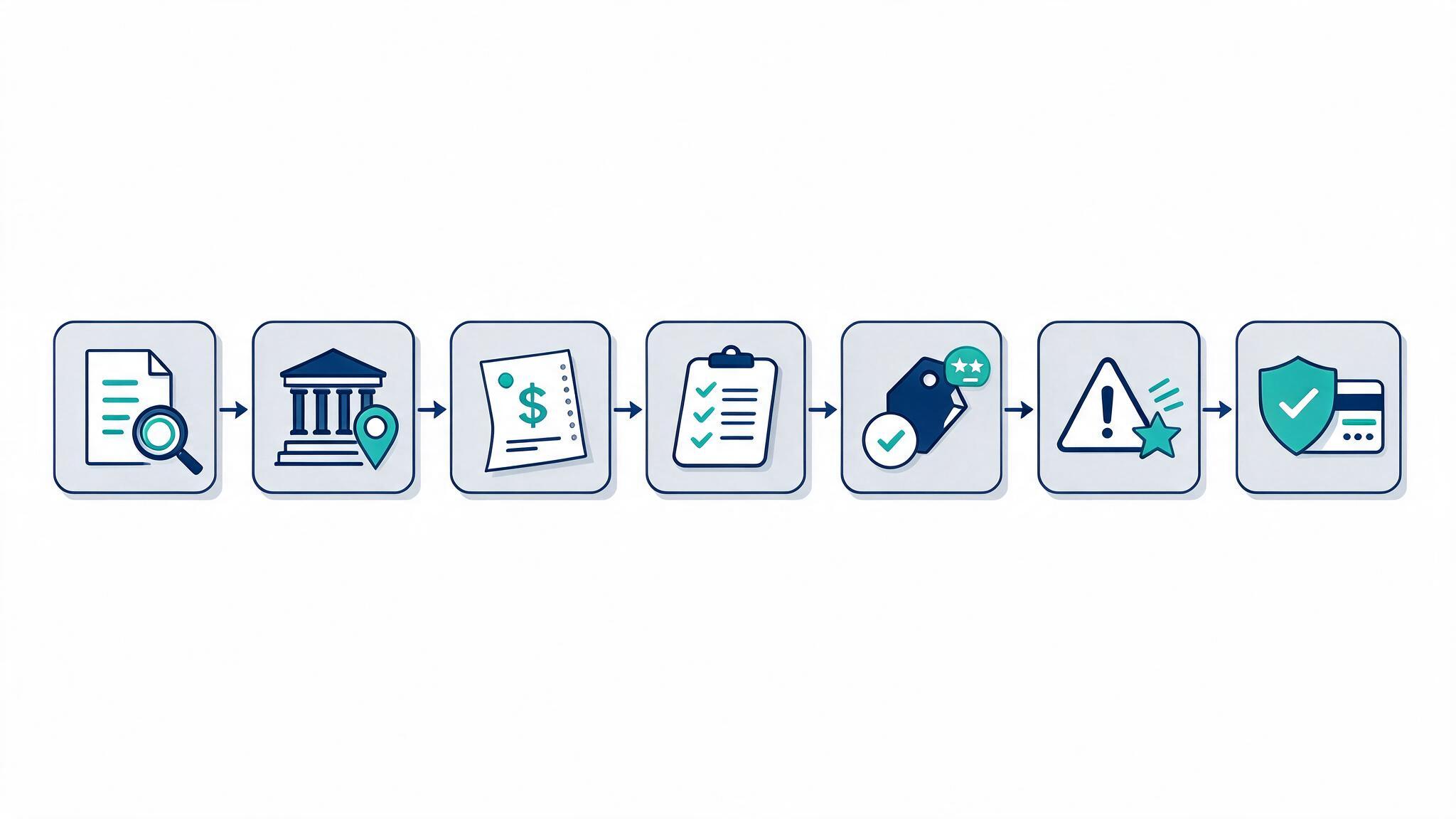
Run every new platform through this list before you register. It takes about twenty minutes.
- Find the legal entity. Look for a company name and address in the terms of service, then check that name in your state’s secretary of state business registry. An unregistered entity is a hard stop.
- Confirm a reachable address and phone number. A warehouse you can find on a map is a good sign. A contact form with no address is not.
- Read the full fee schedule. Look for a buyer’s premium, payment processing fees, per-pallet handling, storage fees for late pickup, and restocking charges on canceled orders.
- Check that manifests are visible before bidding. You should see the item list, quantities, and condition codes while the auction is still open.
- Look for a published condition glossary. Terms like new, like new, customer return, and salvage mean different things on different sites. The platform should define its own.
- Read the bad reviews. Search the company name plus reviews and read the two- and three-star entries rather than the five-star ones. Complaint patterns matter more than the average score, and the Better Business Bureau’s complaint history is another data point.
- Verify the payment path. If a seller pushes you off-platform and asks for a gift card, cryptocurrency, or a peer-to-peer transfer, treat it as fraud. The FTC publishes consumer guidance on these patterns, and they are common in resale and business-opportunity scams.
If a platform fails two or more of these checks, walk away. There is always another auction.
Reading a Manifest Before You Bid
A manifest is the itemized list of what is in the lot. A good one includes a SKU or ASIN, a short description, a quantity, a condition code, and sometimes a retail price column. That retail column is the biggest trap for new buyers: retail value is not resale value.
When you scan a manifest, ask three questions:
- Can I sell this category? If you know beauty and household goods, a pallet of mixed apparel is a bad first buy even at a low price.
- What is the condition mix? A lot labeled customer returns usually spans unopened to broken. Salvage lots are for parts or scrap and should be priced accordingly.
- Is anything missing? Watch for phrases like manifest not guaranteed, counts approximate, or as-is. Those are not automatically bad, but they shift risk to you.
For a deeper look at how return pallets are graded and what tends to be inside them, see our guide to buying customer return pallets at auction.
The Costs People Forget to Budget
The winning bid is only one line on the invoice. Build your budget from the full landed cost, then decide whether the bid still makes sense.
| Cost line | Where it appears | How to confirm it |
|---|---|---|
| Buyer’s premium | Added to the hammer price at checkout on some auctions | Read the auction’s fee page before bidding |
| Sales tax | Applied to the item price, and sometimes to fees | Check your invoice; a resale certificate may change how tax is handled in your state |
| Freight or shipping | LTL freight for pallets, parcel rates for small lots | Request a quote before the auction closes |
| Liftgate or residential delivery | Added when you cannot unload at a loading dock | Ask the freight provider which accessorial fees apply |
| Storage and handling | Charged if you miss the pickup window | Note the pickup deadline the moment you win |
| Your time and supplies | Sorting, testing, photographing, listing, packing | Track it honestly for your first few lots |
A simple break-even formula: add the bid, premium, tax, freight, and any accessorials to get your landed cost. Then estimate how many units you expect to sell and at what average price. If the conservative version of that estimate does not comfortably cover the landed cost, the lot is not a bargain — it is inventory you will be storing.
A Low-Risk First Purchase, Step by Step
- Register and complete verification first. Many platforms ask for a business name, tax ID, or photo ID. Do this before you find a lot you want.
- Watch one full auction cycle without bidding. Note how closing works — many use a soft close that extends the clock when a bid lands in the final minutes.
- Buy one small lot in a category you already understand. A single pallet in a niche you could sell without research is the right first purchase.
- Pay through the platform and keep the invoice. Traceable payment is your only real recourse if something goes wrong.
- Photograph the pallet before you open it. If the load arrives damaged, photos and freight paperwork support a claim.
- Track actual sell-through for 30 days. Compare what you recovered against the landed cost before buying lot number two.
On taxes: if you buy specifically to resell, most states offer a resale certificate or permit that changes how sales tax is handled, and resale income is generally reportable. Rules vary by state and by your situation, so confirm the details with a qualified tax professional rather than a forum post.
Red Flags That Should End the Deal
- Pressure to pay off-platform, especially by gift card, crypto, or a peer-to-peer app.
- No manifest until after payment, or a manifest that is a photo of a handwritten list.
- Guaranteed-profit language. Resale margins depend on category, season, and selling channel.
- Prices far below market for sealed, in-demand electronics — the classic bait in pallet fraud.
- Direct messages offering unclaimed Amazon pallets. Amazon does not sell unclaimed pallets to consumers through social media DMs.
- A brand-new account with a burst of identical five-star reviews posted in the same week.
We break these down further in how to spot fake liquidation pallet ads.
Where Beginners Should Start
Start with retailer-operated marketplaces and established auction houses that publish manifests and terms. Well-known names in the space include B-Stock, Liquidation.com, and Bulq, along with regional auction houses that have moved bidding online — check each site’s current terms, fees, and seller list yourself, because policies change.
Two alternatives are worth considering before you commit to pallets. First, clearance arbitrage: buying deeply discounted retail stock and reselling it is slower but far less risky, and knowing the Target clearance markdown schedule helps you time those buys. Second, small parcel lots instead of full pallets, which let you test a category without committing to freight.
Whichever route you take, the discipline is the same: verify the seller, read the manifest, calculate the landed cost, and buy small until your own numbers tell you it works.