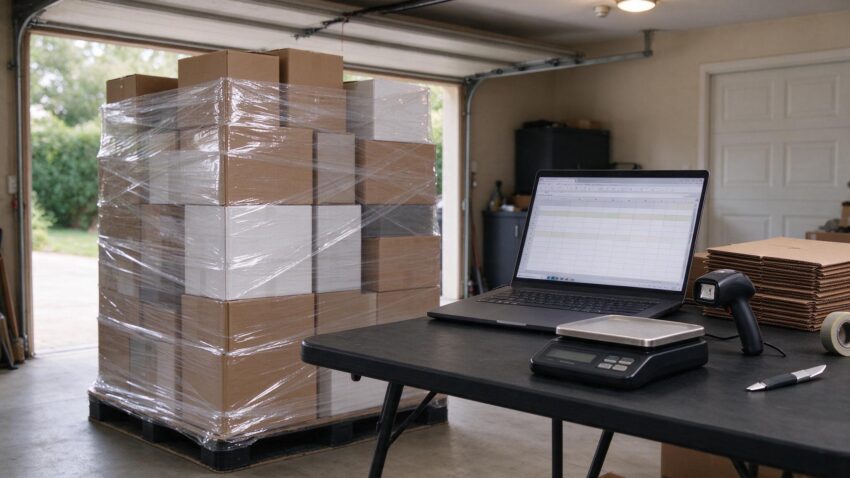
Reselling liquidation pallet profit margins are the gap between what a pallet costs you to land and what it actually brings in after marketplace fees, shipping, labor, and returns. Two buyers can win identical pallets at the same price and end up in completely different places, because the winning bid is only one line in a much longer cost stack. This guide breaks that stack down, shows how to estimate margin before you bid, and covers the habits that separate a profitable flipping operation from an expensive hobby.
What Profit Margin Means on a Liquidation Pallet
Before the math, agree on the terms. Three numbers get mixed together constantly in reseller forums, and mixing them up is how people talk themselves into bad purchases.
- Gross margin — sales minus cost of goods, divided by sales. It ignores fees, freight, and your time.
- Net margin — sales minus every cost, divided by sales. This is the number that pays your bills.
- Return on cash — net profit divided by the total cash you tied up. A pallet can post a modest net margin and still be a smart use of cash if it turns quickly.
A healthy net margin on a pallet you clear in three weeks is a different business from the same margin on a pallet that drags on for nine months. Always pair margin with sell-through time, because slow inventory quietly eats storage space, listing effort, and sometimes value itself.
The Cost Stack That Decides Reselling Liquidation Pallet Profit Margins

The hammer price is the headline; the cost stack is the story. Every pallet carries a group of costs that arrive before your first sale and a second wave that arrives after it.
| Cost line | What it covers | Where it hides |
|---|---|---|
| Hammer price | Winning bid on the pallet | Feels like the whole cost, but usually is not |
| Buyer’s premium and platform fees | Auction commission, card processing, sometimes a per-lot fee | Added at checkout, so the invoice is higher than the bid you remember |
| Freight or pickup | LTL shipping, liftgate service, pallet jack rental, fuel, tolls | Quoted separately and easy to underestimate on a road trip |
| Sales tax | State and local tax on the purchase, where applicable | Rules vary by state and by whether you hold a valid resale certificate |
| Sorting and inspection labor | Unwrap, count, test, photograph, list | Invisible if you do not pay yourself, very real if you hire help |
| Rework | Cleaning, missing parts, batteries, cables, repackaging | Shows up as a dozen small purchases |
| Outbound shipping supplies | Boxes, tape, bubble wrap, polymailers, labels | Runs continuously and rarely gets counted per pallet |
| Marketplace fees | Referral or final value fees, payment processing, optional promoted listings | Deducted from the payout, so you never see the full sale price |
| Returns and refunds | Refund plus return shipping, and sometimes the item comes back unsellable | Arrives months later, after you already spent the profit |
| Dead stock | Units that cannot be sold as-is: donate, bundle, or scrap | The single biggest reason quoted margins fail in practice |
Two lines deserve special attention. Dead stock is where optimistic spreadsheets break, because a customer return pallet planned as if everything works will disappoint — some units arrive damaged, incomplete, or locked to a previous owner. Build an unsellable allowance into your plan instead of discovering it in week three.
Marketplace fees deserve the same respect. Referral fees and final value fees vary by category and by platform, and they change over time. Confirm the current fee schedule on the platform’s own fee page before you price anything, and use the real number for the category you are selling in rather than a figure you remember from last year.
How to Estimate Margin Before You Bid
Margin math is only as good as the inputs. Work through these checks in order, and if a pallet fails one badly, stop rather than averaging it out.
- Read the manifest, not the listing title. A title that says electronics tells you almost nothing. Look at the actual SKU list: how many units, which categories, stated retail values, and whether the mix is focused or a grab bag.
- Check the condition code. New, overstock, customer return, and salvage are different businesses. Returns and salvage need more testing time and carry a higher unsellable rate. Our guide to buying customer return pallets at auction walks through what those labels actually imply.
- Comp against sold listings, not asking prices. Filter by sold and completed items and look at what moved recently in the same condition. An active listing at a high price proves nothing about what buyers pay.
- Estimate sell-through per category. A pallet of seasonal decor in February and a pallet of phone accessories behave differently. Note which categories will sit and which will move.
- Run the pessimistic case. Assume the best few items are broken, the slowest category sells at a discount, and a chunk of the pallet becomes dead stock. If the pessimistic case still works, the pallet is worth pursuing.
- Add the fees on both sides. Buyer’s premium and freight when you buy, marketplace fee and outbound shipping when you sell. For typical price ranges to plug into the buy side, see how much liquidation pallets cost.
A Worked Example Using Hypothetical Numbers
Every figure below is invented to demonstrate the method. None of it is a market average, and your own quotes and comps will differ.
| Line | Hypothetical amount |
|---|---|
| Hammer price | $450 |
| Buyer’s premium (15%) | $67.50 |
| Freight | $120 |
| Sorting labor (8 hours at $15) | $120 |
| Total landed cost | $757.50 |
| Gross sales over eight weeks | $1,350 |
| Marketplace fees (13%) | $175.50 |
| Shipping supplies | $60 |
| Returns and refunds | $75 |
| Net profit | $282 |
Now the three ratios. Gross margin is $1,350 minus $757.50, divided by $1,350, which lands near 44 percent. Net margin is $282 divided by $1,350, about 21 percent. Return on cash is $282 divided by $757.50, roughly 37 percent. Note how quickly a healthy-looking gross margin shrinks once fees, supplies, and refunds appear — and note that the labor line is a real cost even when the hours are yours.
Change one input and the picture flips. If gross sales came in at $950 instead of $1,350, net profit would drop to roughly negative $78. That is the value of running the pessimistic case first.
Practical Ways to Protect Margin After the Pallet Lands
- Sort into three piles immediately. Sell as-is, test and rework, and dead stock. Leaving everything in one pile delays listings and hides problems.
- Match channel to item value. High-value, brandable items usually justify individual listings; low-value items are better bundled into lots where the per-item effort is small.
- Test before you list. A tested item with an honest description reduces refunds, and refunds are the quiet margin killer.
- Price to turn, not to dream. Holding an item for months to squeeze out a few extra dollars ties up cash you could redeploy into the next pallet.
- Liquidate dead stock early. Bundle it, sell it as a single lot for parts, or donate it and keep the receipt. Storage costs more than most people assume.
Red Flags That Erase Margin Before You Start
Some losses are decided before the pallet ships. Watch for a seller who will not share a manifest, who quotes guaranteed returns, or who pushes you off the platform to pay by wire or payment app. Social media ads promising unclaimed Amazon pallets for a fraction of retail are a recurring scam pattern rather than a sourcing channel. Our checklist on spotting fake liquidation pallet ads covers the specific warning signs to compare against before you send money.
Also slow down when the numbers look effortless. If a manifest shows retail values far above what the same items sell for on sold listings, the retail value column is marketing, not a forecast.
Track These Numbers Every Month
You cannot improve a margin you do not measure. Keep a simple log per pallet: landed cost, gross sales, total fees, supplies, refunds, dead stock value, net profit, and days from delivery to sell-out. After a few pallets you will know your own averages for sell-through and unsellable rate, which makes future bids far easier to judge.
Keep business income separate from personal spending, save receipts, and treat sales tax and resale certificates as topics to confirm with a qualified tax professional in your state — the rules vary, and this article is general information rather than tax advice. Once your tracking is consistent, reselling liquidation pallet profit margins stop being a guess and become a number you can plan around.