If you have ever watched a pallet unboxing video and wondered how much do liquidation pallets cost, the honest answer is that there is no single sticker price. A liquidation pallet is an auction lot, so what you pay depends on what is on it, who else is bidding that week, and how far it has to travel to reach your garage. What you can control is how well you understand the pricing, so you can walk into a sale with a maximum number in your head instead of a hope.
Below is how pallet pricing is actually built, which categories tend to sit at the low end and the high end, and the arithmetic you should run before you place a bid.
How Much Do Liquidation Pallets Cost? The Short Answer
Pallet prices cover a very wide range. A small, single-category lot of general merchandise can sell for less than a week of groceries, while a manifested load of electronics from a major retailer can run into four figures. Most first-time resellers stay in the middle: one pallet of mixed customer returns or overstock that hammers somewhere in the low-to-mid hundreds of dollars before fees.
The winning bid, though, is not the price. It is only the first line of the invoice. Your true cost includes:
- Hammer price — what you bid.
- Buyer’s premium — the auction platform’s fee, usually a percentage added to the hammer price.
- Sales tax — charged where applicable, and often calculated on the hammer price plus premium.
- Freight or pickup — shipping a pallet across the country can easily cost more than the pallet itself, which is why local pickup is so popular.
- Labor and supplies — pallet jack or forklift access, a truck or trailer, boxes, tape, labels, and your time.
- Dead inventory — the portion you cannot sell, which you paid for anyway.
Two buyers can win identical-looking pallets at the same price and end up with very different costs per sellable item. That gap is where profit lives or dies.
The Real Cost Stack: Five Layers Between the Bid and Your Garage
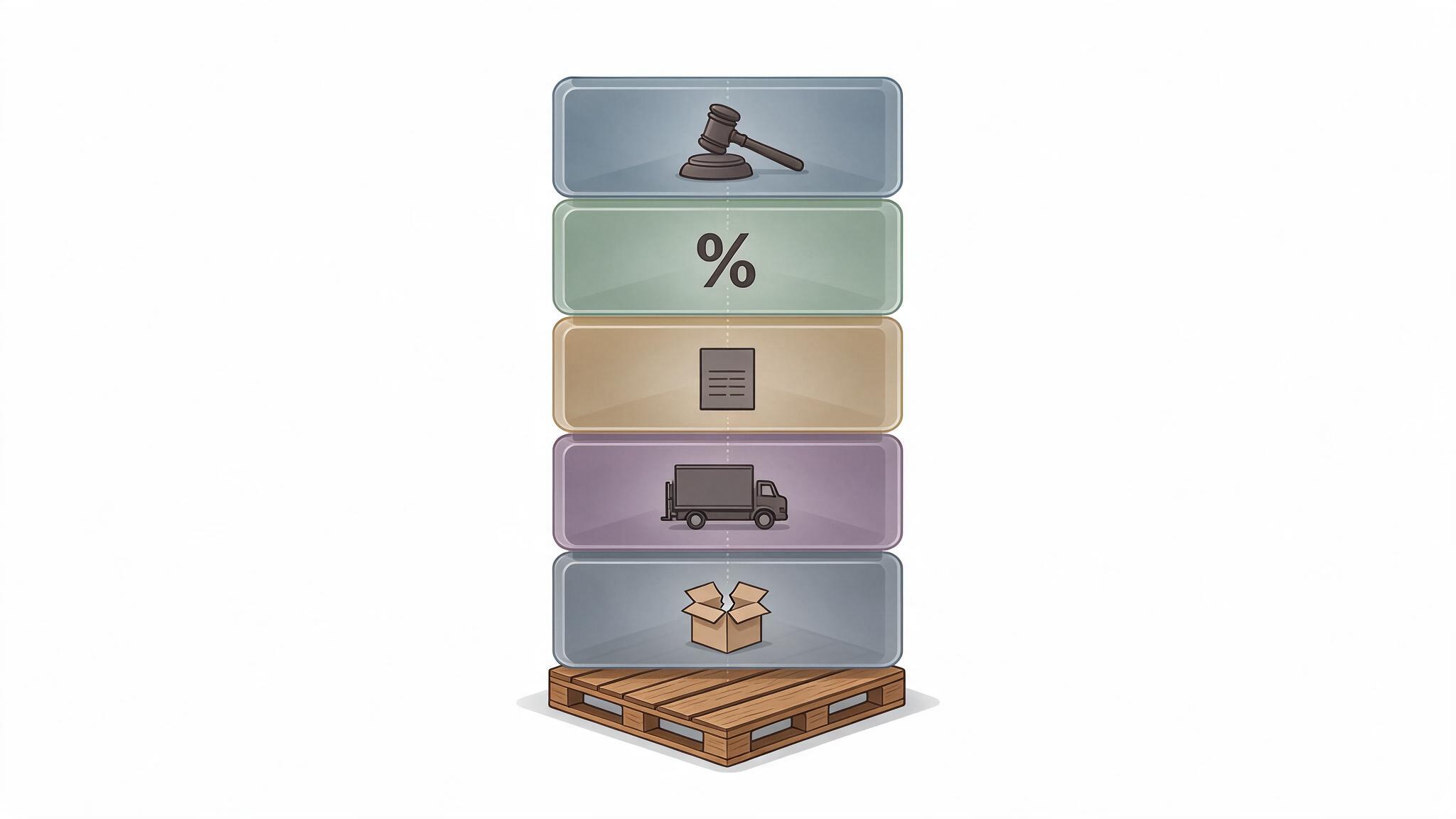
Think of a pallet’s price as a stack of layers. The visible number at the top of the listing is the thinnest one.
1. The hammer price
This is the number the auction ends on. It reflects the crowd that showed up that day as much as the merchandise. Weekend evening auctions with lots of new bidders tend to close higher than weekday-morning sales.
2. The buyer’s premium
Most auction platforms add a percentage on top of your bid. If the premium is 15% and you win at $200, you owe $230 before tax — simple arithmetic you can run in seconds once you know the rate. Always confirm the current rate on the platform’s own fee page, because these terms change.
3. Tax and payment fees
Depending on your state and whether you have a resale certificate on file, sales tax may apply. Card payments can also carry a surcharge with some sellers. Check your state revenue department’s guidance and the platform’s terms — this article is general information, not tax advice.
4. Getting it home
Freight is the layer people forget. A loaded pallet weighs hundreds of pounds and needs a dock, a forklift, or a liftgate. If you are comparing a local pickup lot against an out-of-state bargain, price the freight before you fall in love with the cheap one.
5. The unsellable share
Customer-return pallets contain items that were returned for a reason. Some are perfectly fine; some are missing parts, damaged, or locked to a previous owner’s account. A pallet that looks cheap per unit can turn expensive once you remove everything you cannot resell.
Typical Price Bands by Pallet Type
Exact prices change constantly and vary by platform, region, and season, so treat the table below as a map of where each category tends to sit rather than a quote. Always check live listings for current numbers.
| Pallet type | What is usually inside | Where prices tend to land |
|---|---|---|
| Unmanifested general merchandise | Mixed returns, unknown brands, no itemized list | Lowest band — often under a couple hundred dollars before fees |
| Manifested customer returns | Itemized list from a big-box retailer with SKUs and quantities | Middle band — commonly a few hundred dollars for a single pallet |
| Overstock and shelf pulls | New, unopened goods in one category | Middle to upper band, driven by brand and season |
| High-value categories (electronics, tools) | Small, dense, high-ticket items | Upper band, and the fastest to lose value as models age |
| Multi-pallet and truckload lots | Several pallets or a full trailer | Highest band — often four figures and up, plus freight |
What Moves the Price Up or Down
- Manifest vs. no manifest. A detailed manifest lowers your risk, so it attracts more bidders and a higher price. That is not automatically worse — you are buying information.
- Category. Small, high-value, brand-name goods cost more per pallet than bulky low-value goods, and they also tend to sell faster.
- Condition grade. Sellers often grade lots by how much is expected to be sellable. A higher grade costs more up front and usually saves you sorting time.
- Season. Holiday decor in January and patio furniture in October can be bargains; the same goods in season cost more.
- Location and pickup terms. Lots that require a dock appointment or a long drive attract fewer bidders, which can work in your favor if you have the equipment.
- Bidder count. The single biggest variable you cannot control. Set your maximum before the auction opens and let it go.
Do the Math Before You Bid
Work backward from what you can realistically sell. Estimate the number of sellable units, a conservative average resale price per unit, and your marketplace and shipping fees. Then subtract your total landed cost. If the result is thin, the pallet is too expensive no matter how low the bid feels.
A quick example: a pallet wins at $200 with a 15% buyer’s premium, so you owe $230. Add $60 in local pickup costs and supplies, and your landed cost is $290. If you expect to sell 40 items at an average of $12 after fees, that is roughly $480 in revenue — a workable margin, but only if your sell-through estimate holds. If half the pallet turns out to be unsellable, the same math turns negative. That is why experienced buyers discount their estimates rather than their costs.
If you are new to this, start with a single manifested pallet you can collect in person. Our guide to buying customer return pallets at auction walks through the process step by step, and this list of vetted liquidation auction sites for beginners is a good place to compare fee structures before you register.
Red Flags That Turn a Cheap Pallet Into an Expensive Mistake
- Prices that look far below every other listing in the same category.
- Sellers who only communicate through social media messages and will not provide a business address or a phone number.
- “Unclaimed Amazon pallets” sold for a flat fee with no auction, no manifest, and no inspection.
- Pressure to pay by wire transfer, gift card, or a payment app with no buyer protection.
- No stated return policy, no grading explanation, and no photos of the actual lot.
Cheap is not the same as good value. Our breakdown of how to spot fake liquidation pallet ads covers the specific wording these listings tend to use.
Where to Check Current Pallet Prices
Because prices move with supply, season, and bidding activity, the only reliable way to know what a pallet costs today is to watch live sales. Register on two or three established platforms, follow the same category for a few weeks, and record what lots actually close at — not the opening bids. You will quickly build a personal price guide that is more accurate than any published range, including the one above.
Start small, buy locally when you can, and treat your first few pallets as paid education. Once you know your true landed cost per sellable unit, “how much do liquidation pallets cost” stops being a mystery and becomes a number you set yourself.