
Decode Walmart clearance price endings and you can tell the difference between a price that has already been cut twice and one that is about to drop again. That matters whether you are restocking a pantry, hunting for resale inventory, or just trying to avoid paying full price for something that will be cheaper next week. The catch is that Walmart does not hand out a decoder ring. What follows is a practical, honest guide to the patterns shoppers actually see on the sales floor, plus the in-store checks that confirm whether a number is really a bargain.
What Walmart Price Endings Actually Tell You
Start with the one ending that is close to a company-wide rule: .97. Walmart built its reputation on everyday low prices, and .97 is the ending you will see on the overwhelming majority of regular shelf tags. If an item is .97, it is almost certainly at its standard price. It is not a clearance signal on its own, even if the item happens to sit on an endcap.
Everything past that is a set of observed store-level habits rather than published corporate policy. That distinction matters, because it means the same item can be marked down in one store and full price in the store across town. Walmart’s clearance decisions are largely made by store and department managers, who are reacting to their own inventory, their own floor space, and their own sell-through. So treat the endings below as strong clues, not guarantees.
- .00 endings show up frequently on clearance and on further markdowns of items that were previously .97. You will also see .00 on some regular merchandise, so confirm it with a scan rather than assuming.
- .98 endings are commonly seen on seasonal clearance and on some grocery and household items. The ending alone is not enough — read the tag wording.
- .88 endings tend to appear on promotional or special-buy pricing rather than clearance. A .88 can be a genuinely good deal, but it is usually a planned promotion, not a manager clearing space.
- .50 and .25 endings are the ones shoppers associate with later-stage markdowns, where an item has already been cut once or twice and the store wants it gone.
- .01 endings are the famous “penny items.” These are generally merchandise that was supposed to be pulled from the sales floor after its final markdown. Stores vary in whether they will sell them, and you should never move, hide, or unstick merchandise to force one through. Treat a penny item as a pleasant surprise, never a plan.
Tag wording and color carry as much information as the number. Walmart’s Rollback tags are typically yellow and signal a temporary price reduction on a regular item — the price can go back up. Clearance tags are typically red or orange and signal a permanent reduction while the item is being phased out. A red tag with a .00 ending is a much stronger signal than a yellow tag with a .88 ending.
| Ending | Where shoppers usually see it | How to treat it |
|---|---|---|
| .97 | Standard everyday shelf price | Not a clearance signal by itself |
| .00 | Clearance and further markdowns, plus some regular items | Scan to confirm; often a deeper cut |
| .98 | Seasonal clearance, some grocery and household | Check the tag wording before assuming |
| .88 | Promotions and special buys | Compare unit price against alternatives |
| .50 / .25 | Later-stage markdowns | Good buy if you actually need the item |
| .01 | Items meant to have been pulled from the floor | Do not count on buying these |
If you enjoy this kind of retail detective work, the same logic applies elsewhere. Our breakdown of the Costco price tag asterisk meaning explains how a single symbol can tell you whether an item is discontinued, and it pairs well with what you learn at Walmart.
How to Decode Walmart Clearance Price Endings: A Five-Step In-Store Method
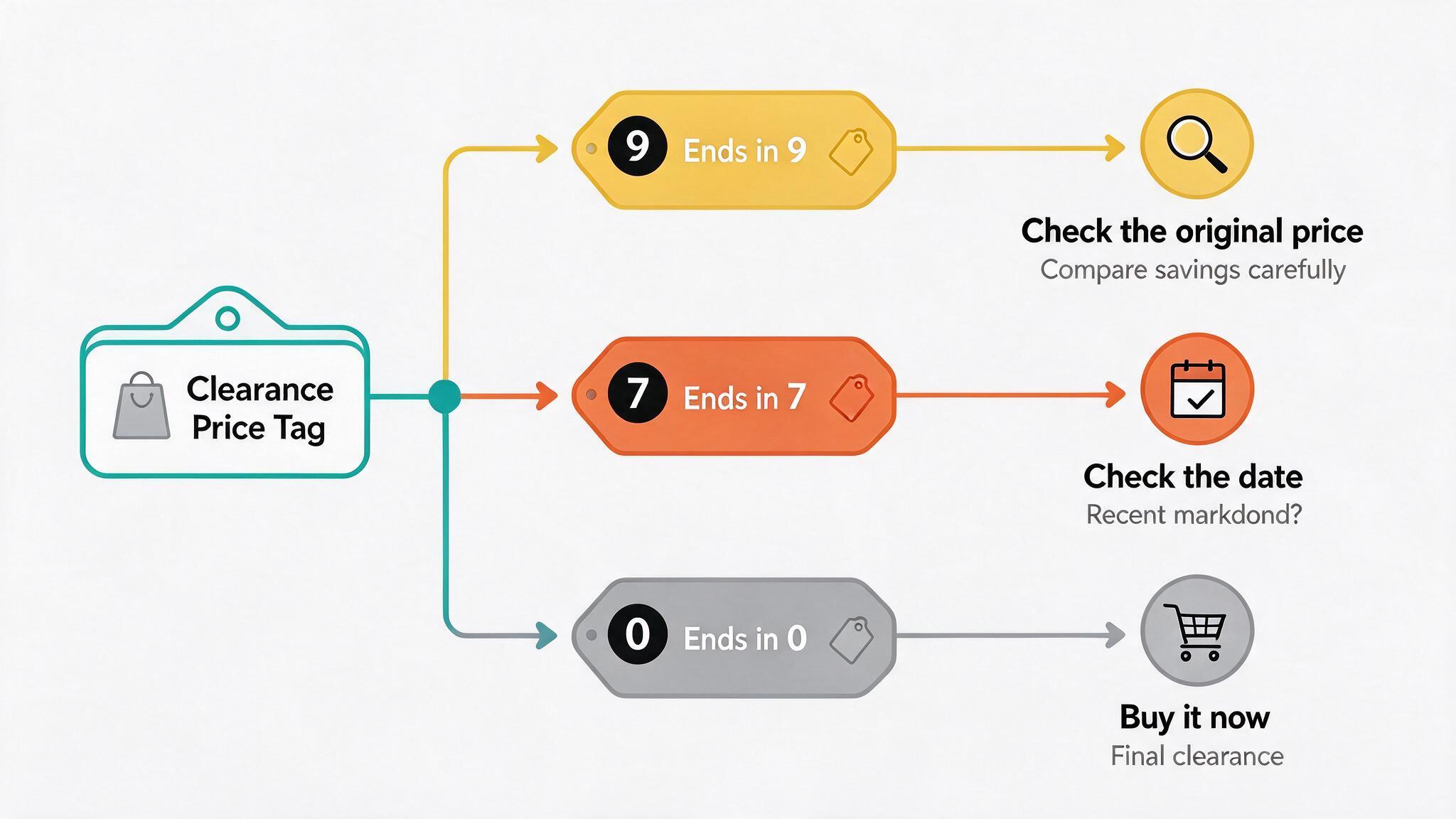
Rather than memorizing a chart, run this sequence every time a tag looks interesting. It takes about thirty seconds per item and prevents most bad buys.
- Read the tag, not just the number. Look for the word Rollback or Clearance and note the tag color. Yellow Rollback means the price is temporary; red or orange Clearance means the item is on its way out. This single step tells you whether waiting is risky or sensible.
- Look at the last two digits. Compare the ending against the table above. A .00 or .98 on a red tag is worth investigating. A .97 on a yellow tag is just the normal price.
- Scan it in the Walmart app. Set your store location first, then use the in-app scanner on the barcode. The app reflects the price for the store you have selected, which is the fastest way to confirm what the register will actually charge. Shelf tags can be outdated or misplaced.
- Check for a markdown date. Some clearance stickers include a date stamp showing when the price was last reduced. If yours does, note it. Shoppers often report that clearance items get a second or third cut after a couple of weeks, but the cadence is set store by store and there is no published schedule. A date stamp at least tells you how fresh the current price is.
- Decide with a rule, not a feeling. If you need the item and the price beats your realistic alternative, buy it. If you are buying only because the tag is red, walk away — clearance piles are designed to make the decision feel urgent when it is not.
One more check that many shoppers skip: compare the unit price, not the sticker price. A larger clearance box is not automatically the better deal, and Walmart shelf labels usually print the unit price in small type. For resellers, that unit price is also your cost basis, so it belongs in your notes.
Where and When Walmart Clearance Actually Shows Up
Walmart does not run a company-wide clearance calendar the way some retailers publish markdown rhythms. Because clearance is store-managed, timing varies by region, by department, and by how quickly that store sells through seasonal stock. What you can rely on are broad seasonal patterns rather than specific dates.
Clearance concentrates in a few predictable places:
- Seasonal transition zones. Patio furniture, pool supplies, and summer toys get cut as fall approaches; holiday decor and winter gear get cut in the weeks after the holidays. These are the deepest and most reliable markdowns of the year.
- Endcaps and back aisles. Dedicated clearance sections often sit near garden, seasonal, or the back wall rather than in the middle of a department.
- Departments facing a reset. Toys, electronics, and apparel get cleared when a new model year or planogram arrives.
- Discontinued and package-change items. When a brand changes its packaging or a store stops carrying a size, the remaining stock usually gets a red tag.
If you like planning around markdown rhythms, it helps to study a retailer that does publish a more predictable pattern. Our guide to the Target clearance markdown schedule walks through how that chain’s drops are structured, and the contrast will make Walmart’s store-by-store approach much easier to read.
Red Flags, Myths, and Costly Mistakes
Clearance hunting attracts misinformation, and a few of these traps cost people real money.
- Paid “clearance list” apps and sites. Nobody outside Walmart can see a specific store’s clearance inventory in real time. If a service charges you for a list of penny items or clearance SKUs, treat it as a red flag rather than a shortcut.
- The penny-item obsession. Chasing .01 items by digging through bins, moving displays, or peeling stickers is a fast way to get asked to leave. It also is not a reliable sourcing strategy.
- Assuming a red tag means the lowest price. A first clearance cut is often only a small percentage off. If you do not need the item today, waiting for a second cut is a legitimate strategy — just accept the risk that it sells out.
- Confusing Rollback with Clearance. Rollback prices can return to normal. Buying a Rollback in bulk because you think it is being discontinued is a common and expensive mistake.
- Fake liquidation and giveaway offers. Social media ads promising “unclaimed Walmart pallets” or free gift cards are a well-worn scam format. Our checklist on how to spot fake liquidation pallet ads covers the tells, and if an offer is framed as a sweepstakes, compare it against the real rules in our guide to no purchase necessary sweepstakes rules. Legitimate promotions never require you to pay a fee or share a payment method to claim a prize.
Finally, be realistic about the drive. A 40-mile round trip to chase a rumored clearance aisle costs gas and time. Unless you are buying in volume, the math rarely works.
Turning Walmart Clearance Finds Into Resale Inventory
Clearance sourcing is a legitimate entry point for small resellers, but it is a thin-margin game. Before buying multiples, work out your landed cost — item price plus tax plus your time and shipping supplies — and compare it against what the item is actually selling for, not what it is listed for. Completed-sale data matters far more than asking prices.
Two habits keep clearance reselling profitable. First, stick to categories you understand, because a deep discount on an unfamiliar product is still a bad buy if it does not sell. Second, keep clearance as a supplement rather than your only source. Many resellers combine store clearance with bulk sourcing, and buying customer-return pallets at auction is a common next step — our buyer’s guide to customer return pallets at auction explains how manifest-based lots work. If you go that route, start with vetted platforms rather than social media sellers, as outlined in our starter guide to vetted liquidation auction sites.
One last note on tax: reselling generally means tracking inventory costs and possibly collecting sales tax, and the rules vary by state. This article is general information, not tax or legal advice — talk to a qualified professional about your specific situation.
The Bottom Line
Walmart price endings are a useful shorthand, not a secret code. The .97 ending is the everyday price. Red and orange clearance tags with .00, .98, .50, or .25 endings are the ones worth a second look. The Walmart app scanner is your source of truth for what the register will charge, and the tag wording tells you whether the price is temporary or permanent. Read the tag, scan the barcode, check the unit price, and buy only what you would have bought anyway. That approach will save you more money than any list of penny items ever will.