
Buying overstock and customer-return pallets is not a secret club — it is a supply chain, and anyone with a laptop, a vehicle, and a modest budget can bid into it. This guide explains how everyday shoppers buy overstock return pallets for pennies on the dollar: where the pallets come from, what the real cost stack looks like, how to read a manifest before you bid, and which listings are built to separate you from your money.
Where Overstock and Return Pallets Come From
Every large retailer faces the same three problems: merchandise that did not sell, merchandise that came back, and merchandise that arrived damaged, late, or out of season. Stores can only return so much to the shelf. The rest has to leave the building, and it leaves in bulk because selling one pallet is far cheaper than selling four hundred individual items.
That bulk exit is where you come in. Retailers and their third-party logistics partners sell truckloads, partial truckloads, and single pallets to whoever bids highest. The lots are usually sorted into recognizable buckets:
- Customer returns — items shoppers sent back. Some are unopened and perfect, some are missing a part, and some are the wrong item in the right box.
- Overstock — never-sold inventory, often still sealed in original case packs.
- Shelf pulls — pulled for a planogram reset, a packaging change, or a seasonal transition.
- Salvage — damaged, untested, or incomplete goods. Cheapest per unit and the riskiest.
Most listings also carry a condition grade — words like new, like new, used, or salvage/untested. Treat a grade as the seller’s shorthand, not a warranty. Two pallets graded the same way can perform very differently, which is why experienced buyers look at category mix and grade together instead of trusting a single label.
What “Pennies on the Dollar” Actually Means — and What It Doesn’t
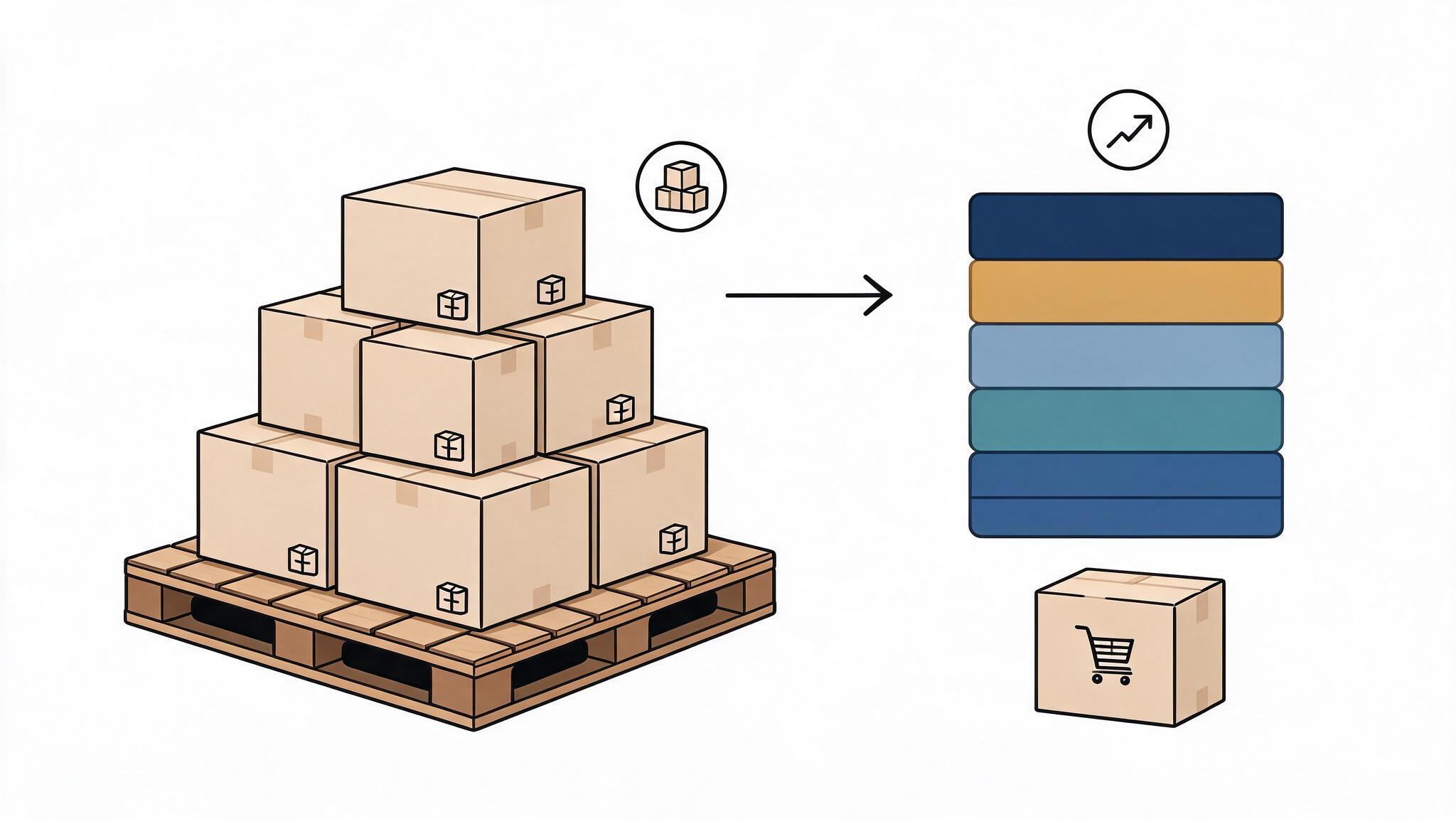
The phrase is honest, but it is easy to misread. The “dollar” in pennies on the dollar is the original retail price printed on the manifest — not the price you will actually get. A pallet advertised at a small fraction of its stated retail value is not automatically a profit.
The number that matters is your cost per sellable unit. Add up the hammer price, the buyer’s premium, sales tax, freight or pickup costs, and supplies. Then divide by the number of units you can realistically sell — not the number of units on the pallet. If the result lands close to what the item sells for used, you do not have a deal; you have a chore.
Two traps catch first-time buyers again and again. The first is comparing your cost to MSRP. Very few shoppers pay full MSRP in most categories, so use current sold prices on the marketplaces where you plan to sell, not the retail figure on the manifest. The second is ignoring the unsellable rate. Every pallet contains a share of items that will never sell: broken, incomplete, expired, or simply unwanted. Plan for that share before you bid, not after.
Used correctly, the math still works. Pallets routinely sell for a small fraction of their original retail value, and the buyers who do well are the ones who price in the mess.
Where to Find Legitimate Pallet Auctions
Legitimate liquidation inventory is sold through channels that publish terms, manifests, and contact details. The main ones:
- Online liquidation marketplaces. Business-to-business auction platforms that list pallets and truckloads with manifests and published fee schedules. Vetted liquidation auction sites for beginners covers how to tell a real platform from a storefront with a logo.
- Retailer-run liquidation programs. Some large retailers and their logistics partners run their own auction channels rather than selling through a third party.
- Regional liquidators with a physical warehouse. Being able to walk the floor, inspect a sample pallet, and pick up in person removes most of the risk.
- Local general auctions. Smaller volume, but you can often inspect before bidding and skip freight entirely.
What you will not find is a legitimate channel that gives pallets away. Amazon does not hand out “unclaimed” pallets to individuals; its liquidation inventory moves through business-to-business channels. Any post promising free pallets, unclaimed Amazon returns, or a guaranteed electronics haul in exchange for a small “shipping fee” is a sales pitch, not a supplier.
The Real Cost Stack: What You Pay Beyond the Hammer Price
New buyers budget for the winning bid and nothing else. Use this table as a checklist before you place a bid.
| Cost line | What it is | Where to confirm it |
|---|---|---|
| Hammer price | Your winning bid | The auction listing |
| Buyer’s premium | A percentage the auction house adds on top of your bid | The platform’s terms or fees page — it varies widely by seller |
| Sales tax | Charged on taxable merchandise in many states | Your state department of revenue and the platform’s checkout |
| Freight or pickup | LTL shipping, liftgate, residential delivery surcharge — or fuel and time to collect it yourself | Request a written quote before the auction closes |
| Supplies | Boxes, tape, labels, mailers, cleaning wipes, batteries for testing | Your own budget |
| Storage | Garage space or a rented unit while items sell | Local storage rates |
| Your time | Sorting, testing, photographing, listing, packing, answering messages | Track it for a month and see |
Freight is the line that surprises people most. Pallets are heavy and awkward, and residential delivery often requires a liftgate and carries a surcharge. If you cannot pick up in person, get the shipping cost in writing before the auction closes — not after you win.
How to Read a Manifest Before You Bid
A manifest is a list of what the seller says is in the lot. Quality varies enormously, so read it like a skeptic.
- Check the category mix. A pallet of fifty phone cases is not the same opportunity as a mixed general-merchandise pallet, even at the same price.
- Look for a condition column. If every line says “new,” ask how that was verified. If it says “untested,” price it as untested.
- Compare the stated count to the actual count. Some manifests are guaranteed; many are approximate. The terms page will say which.
- Scan for the same item repeated. Deep quantities of one product mean you are buying inventory, not variety — and you will compete with everyone else selling that same item.
- Ask questions in writing. A legitimate seller answers before the auction closes. Silence is an answer too.
Red Flags to Check Before You Pay
Fake pallet ads are common because the pitch is emotionally perfect: cheap goods, big upside, limited time. Run this checklist before any payment.
- Payment is accepted only through peer-to-peer apps, with no card or invoice option.
- No physical address, no warehouse photos that match a real location, no verifiable business registration.
- Language like “unclaimed pallets,” “lost Amazon packages,” or “guaranteed resale value.”
- A countdown timer with no inspection window and no published terms.
- Photos that turn up in other listings when you reverse-search them.
- Prices far below the going rate for a comparable manifested lot.
- Pressure to pay a deposit to “hold” a pallet you have never seen.
Our guide to spotting fake liquidation pallet ads walks through these in more detail. If you have already paid and the seller has gone quiet, report it to the FTC at ReportFraud.ftc.gov, file with your state attorney general’s consumer protection office, and check the seller’s record with the Better Business Bureau.
Selling What You Buy: The Other Half of the Math
Buying cheap is only half of the equation. The other half is turning inventory into cash without losing your margin to fees and time.
Marketplace selling adds referral fees, payment processing, and shipping costs, plus the occasional return. Local selling — flea markets, community sales, local pickup apps — avoids shipping but consumes weekends. Most resellers do both: high-value, light, easy-to-ship items online; bulky or low-value items locally.
Track your sell-through rate by category. If a category takes months to move, it is tying up cash and shelf space even when each individual sale looks profitable. Reselling liquidation pallet profit margins breaks down where the money actually goes.
One more thing: if you buy with the intent to resell, you are running a business, not a hobby. That means keeping records of what you paid, what you sold, and what you spent on supplies and freight. The IRS treats hobby and business income differently, and the rules are specific. This is general information, not tax advice — talk to a qualified tax professional about your situation.
A First-Pallet Checklist
- Set a total budget, not a bid limit. Include premium, tax, freight, and supplies.
- Pick one category you already understand. Do not learn a new product category and a new auction platform at the same time.
- Read the platform’s terms page for buyer’s premium, payment deadlines, and pickup windows.
- Request the manifest and a shipping quote before the auction closes.
- Compare manifest retail prices against current sold prices for the same items.
- Assume a meaningful share of the pallet will not sell, and check that the numbers still work.
- Buy one pallet. Sell it out completely before you buy a second.
- Log your real costs and your real sale prices so your next bid is based on data instead of optimism.
The shoppers who consistently buy well are not the ones who find the cheapest pallet. They are the ones who know exactly what a pallet has to earn before it is worth the space in their garage.